Licensed Georgia Household Goods Carrier

Commercial & Office Movers in Atlanta, GA — Relocations Planned Around Your Downtime

  • 4.7 Google · 356+ reviews
  • Licensed & Insured
  • After-Hours & Weekend Planning
  • Background-Checked Moving Professionals

For a business, the move itself is rarely the hard part — the hard part is staying open while it happens. An office relocation lives and dies on timing: which freight elevator you can reserve in a Downtown or Midtown tower, when the building lets a crew use the dock, how long the loading-zone window actually lasts on a working street, and how many hours you can afford the phones and workstations to be down. We plan the move backward from that — the close-of-business cutoff, the after-hours or weekend window, the order desks and IT and furniture come apart and go back together — so Monday opens like nothing moved. Offices, retail buildouts, equipment, and workspace transitions across the metro, quoted from a walkthrough rather than a guess.

Request a Commercial Move Quote

A few details about the spaces and timing — we’ll scope it and follow up to plan a walkthrough.

Walkthrough-based quote — no obligation to book.

By submitting, you're asking LIOO Moving to contact you by phone and email about your move.

Prefer an instant online estimate? Try the 30-second estimator →

Quick answer

Commercial moving in Atlanta, at a glance

Commercial movesLicensed GA Household Goods CarrierInsured crews + COIsAfter-hours & weekend schedulingMinimal-downtime planning

A commercial move is any relocation of a business rather than a household: an office, practice, shop or warehouse, with its furniture, files and equipment. LIOO Moving prices it on the same hourly rate card as a household move — $160 an hour for two movers and one truck up to $320 for six — with the crew size and hours set at the walkthrough, and schedules it around your downtime — most Atlanta business relocations run after hours or over a weekend so your team is productive the next business day. LIOO Moving handles office, medical and dental, IT and server-room, law-firm, retail, and light-industrial relocations — including furniture disassembly and reconfiguration, and clearing out furniture that is not making the move — as a Licensed Georgia Household Goods Carrier with insured crews and certificates of insurance for building management.

Page updated 3 October 2026 · Rates confirmed October 2026 · Reviewed by Tavion McCullough, Operations Lead

Move typeTypical schedulingWhat it covers
Office relocationAfter hours / weekendWorkstations, furniture, files, and IT equipment your IT team has disconnected
Medical & dentalWeekend / phasedCareful handling of equipment and boxed records
IT & server roomOff-peak windowTransport timed to your IT team’s teardown and reinstall
Retail & restaurantOvernight / closed hoursFixtures, inventory, and equipment moves
Warehouse & light industrialScheduled to scopeInventory, furniture, and equipment with the right crew size

Office, medical & industrial

Commercial Movers in Atlanta: Office, Medical & Industrial Moves

LIOO Moving coordinates commercial relocations across metro Atlanta — office, medical, dental, legal, retail, and light industrial moves into and out of Class A high-rises, suburban office parks, adaptive-reuse buildings, and warehouse space. Our crews work the operational layer most tenants never see: Certificates of Insurance written with each building's specific additional-insured language, freight elevator and loading dock reservations made with property management where the building allows it, or planned around the tenant’s booking where it does not, after-hours sequencing through Buckhead, Midtown, Downtown, and the Perimeter, and IT disconnect/reconnect timed to the client's MSP or internal team. We move single-suite tenants, whole-floor consolidations, decommissioning projects, and multi-building relocations across weekend windows throughout the Atlanta metro area.

Paperwork before boxes

What a Commercial Move in Atlanta Actually Involves

Commercial moves in Atlanta start with paperwork, not boxes. Most Class A buildings — Bank of America Plaza, One Atlantic Center, Three Alliance Center, Promenade, 1180 Peachtree, Terminus, Concourse at Landmark Center — require a Certificate of Insurance naming the building owner and property manager separately as additional insured, using the building's own indemnification language. Each property management team sets its own deadline for the certificate, so we request the building’s requirements as soon as the date is booked. We send the COI to the management contact, confirm acceptance in writing, and only then lock the dock time — booked by us where the building allows it, by the tenant where it does not.

Freight elevators and loading docks are reserved separately, by the hour, and almost always require a building security escort during off-hours. Older building stock around Five Points and the Marietta Street corridor has smaller freight cars that won't take a 60-inch credenza or a full-height lateral file without disassembly. Newer Buckhead and Midtown towers have larger cars but stricter dock-time windows, and some buildings charge tenants for after-hours security or dock time; ask your property manager whether yours does. During the walkthrough we measure the freight car, the door opening, and the hallway turn into the suite — three measurements that determine whether a piece rides up assembled or comes apart first.

The majority of Atlanta office moves run between 6 PM Friday and 6 AM Monday. Tenants schedule it that way because building leases restrict freight traffic during business hours and because no one wants their team sitting at a half-disassembled workstation on Monday morning. We plan crew shifts around the building's after-hours access window, not the clock — Promenade closes its dock at different hours than Concourse at Landmark Center, and Ponce City Market handles retail-tenant moves on a different protocol than its office tenants.

Route planning matters more in Atlanta than people outside the city assume. I-285, the Downtown Connector, and the I-75/I-85 split through Midtown all back up at predictable hours, and a crew staging at Cumberland on a Braves home night will lose 30 to 60 minutes to Truist Park traffic if they don't leave early. For North Fulton moves up the GA-400 corridor — Alpharetta, the Avalon area, North Point — we stage trucks differently than for an intown Buckhead-to-Midtown shift, because the highway exposure is longer and the dock arrival timing is less flexible.

What we move

Commercial Moving Services LIOO Provides

Office relocation

Workstation disassembly and reassembly across Herman Miller, Steelcase, Knoll, Haworth, and Allsteel systems — including panel-based and benching configurations. Every workstation, file pedestal, and conference room piece gets a color-coded label tied to a numbered placement plan, so crews place by map, not by guess. Executive offices and conference rooms move as kitted units when the building's freight access allows it, which cuts reassembly hours on the destination side.

IT and server room moves

Computers, monitors, printers and network gear move padded and boxed after your internal IT team or managed service provider has shut them down and disconnected them. We don’t disconnect cabling we didn’t tag, and we don’t reconnect without IT present. For server rooms, we move the hardware IT has prepared and schedule the truck around their cutover plan, so the rebuild window is set by IT, not by the truck’s arrival.

Medical and dental office relocation

Medical, dental, and specialty practice moves require sequencing that protects equipment — chairs, cabinetry, and devices your equipment vendors have disconnected — and minimizes patient downtime on either end. Boxed records and charts stay sealed, labeled by room, and moved as a group; if the practice needs a signed chain-of-custody record, we plan the handoff with your records staff. Rooms move in clinical order so the practice can resume operations on a defined day rather than waiting on miscellaneous reassembly.

Law firm and financial services moves

Law firms, accounting practices, and financial services tenants move with file integrity as the primary constraint. We label by office, by file room, and by retention category; plan a signed handoff with your records staff when the firm requires one; and sequence library and file room transport so closed files arrive first and active files arrive last. Partner offices and conference rooms can be moved as individually kitted units when requested.

Retail and restaurant relocation

Retail and restaurant relocations are scheduled around operating hours. Most run overnight or across a single closed day, with fixtures, FF&E, and POS hardware moved as defined kits. We coordinate with landlord and adjacent-tenant restrictions for centers where one tenant's move can't block another's loading access — common in West Midtown's Westside Provisions corridor and along the Ponce de Leon retail strip.

Warehouse and light industrial

Warehouse and light industrial moves are scoped at the walkthrough: crew size, truck count, and which palletized loads the facility’s own forklift and operator will handle. Pallet sequencing and load lists move with the freight so receiving on the destination side can stage inventory without re-sorting on the dock.

Furniture installation and reconfiguration

Modular system reconfiguration — moving a 40-station floor to a 60-station benching layout, for example — handled in place or in conjunction with a relocation. Day-two punch lists cover the workstation adjustments, missing hardware, and panel leveling that always surface once people sit down on Monday.

Clearing out the old space

For tenants leaving a space empty, furniture that is not making the move can be carried out to a donation pickup, a recycler, or a dumpster you arrange, on the same hourly rate as the move. Tell us at the walkthrough so the crew and the time are planned for it.

Eight submarkets

Atlanta Submarkets We Move In and Out Of
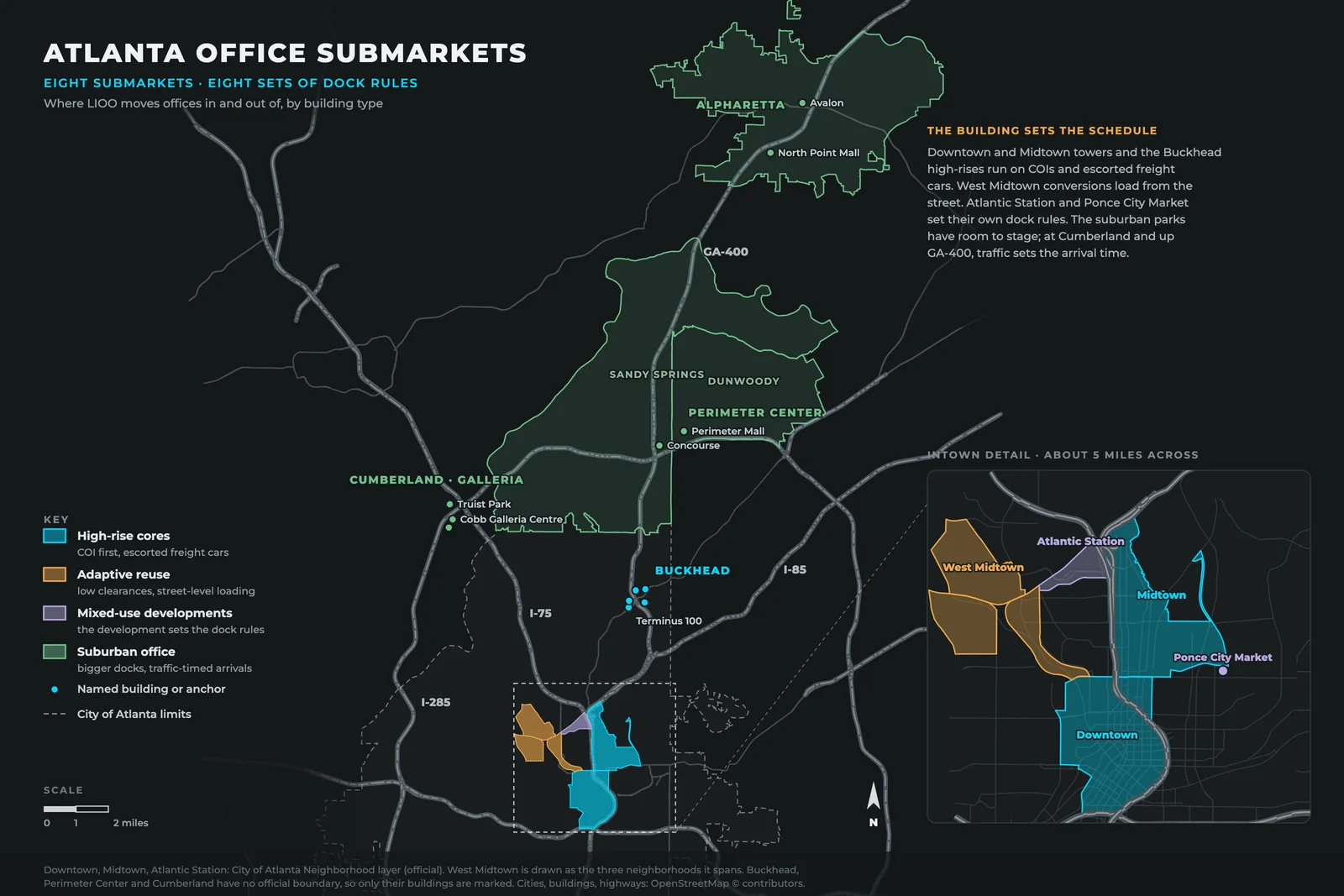
Map of the Atlanta office submarkets LIOO Moving works in: Downtown, Midtown and Atlantic Station from the City of Atlanta neighborhood layer, West Midtown drawn as the three neighborhoods it spans, the named Buckhead towers, Perimeter Center with Perimeter Mall in Dunwoody and Concourse in Sandy Springs, Cumberland and the Galleria with Truist Park outside the city in Cobb County, and Alpharetta with Avalon and North Point Mall, joined by I-285, I-75, I-85 and GA-400, with an intown inset that adds Ponce City Market.
The eight submarkets on one map: the high-rise cores of Downtown, Midtown and Buckhead, the West Midtown conversions, the Atlantic Station and Ponce City Market developments, and the suburban office parks at Perimeter Center, Cumberland and Alpharetta.

Buckhead

Class A high-rise density runs the show in Buckhead. Three Alliance Center, Terminus, Tower Place, Phipps Tower, and the Lenox-area towers all enforce strict COI requirements and tight after-hours windows. Tenant moves here typically run Friday night through Sunday, with building security escorting every freight elevator trip. Where the building lets the mover book the dock, we book it with property management; where it takes the booking only from the tenant, we plan the crew around the window you secure. See Buckhead office relocation logistics for building-specific notes.

Midtown

Midtown moves cluster around Tech Square, Colony Square, and the Peachtree Street tower corridor. Several buildings have integrated security check-in systems that require crew rosters submitted in advance, with photo ID matched on arrival. Freight access at most Midtown towers is more generous than Downtown's older stock but stricter than the Perimeter's, and weekend dock windows fill quickly in the spring and fall moving seasons. More on Midtown high-rise moves.

Downtown

Older building stock dominates Downtown — smaller freight elevators, narrower service corridors, and tighter dock approaches than the towers in Buckhead or the Perimeter. Around Five Points, Centennial Park, and the Marietta Street corridor, street parking restrictions can force trucks to stage off-site and shuttle. Weekend dock availability is often better here than midweek, which makes each building's after-hours access policy the deciding factor in scheduling. See Downtown Atlanta commercial moves.

West Midtown

West Midtown's adaptive-reuse buildings — converted warehouses and mill conversions along Howell Mill, Marietta Street, and the Westside Provisions corridor — often have lower freight clearances and street-level loading instead of dedicated docks. Parking is tight along Northside Drive; we typically pre-arrange cone-off zones with the landlord when truck access is limited. Household moves in the corridor are quoted on the West Midtown page.

Perimeter and Central Perimeter

The Perimeter submarket — Dunwoody, Sandy Springs, and the office parks along Ashford-Dunwoody and Hammond — offers larger dock capacity, easier crew staging, and weekday-friendly move windows that intown buildings can't accommodate. Buildings range from suburban Class A towers to one- and two-story office parks, so loading approach and elevator access vary widely. A walkthrough matters more here than the building's marketing material. See Dunwoody business relocation and Sandy Springs office moves.

Cumberland and Galleria

Cumberland/Galleria — the office cluster around the I-285/I-75 interchange and the Battery Atlanta — adds a wrinkle most Atlanta submarkets don't: Truist Park game-day traffic. Crews staging here on a home-game evening lose 30 to 60 minutes to incoming traffic, so we plan dock arrival around the schedule. Office park access is otherwise straightforward. More on Cumberland commercial moves.

Alpharetta and the North Fulton tech corridor

North Fulton — Alpharetta, the Avalon and North Point area, and the GA-400 corridor up through Cumming — runs more single-tenant and low-rise office buildings than intown. Dock access is generally easier; the longer haul up GA-400 is the operational constraint, since a closed lane in the morning can stretch a one-hour move-out by 90 minutes. We stage start times around the corridor's traffic pattern. See Alpharetta business moves.

Atlantic Station, Ponce City Market, and mixed-use developments

Mixed-use developments operate differently than standalone office buildings. Atlantic Station coordinates retail and office tenant moves through separate dock protocols. Ponce City Market requires advance reservation for the freight dock and limits move windows to off-peak hours so foot traffic on the Beltline-adjacent retail level isn't disrupted. We deal with the development's tenant services team directly to align timing across both office and retail tenants.

Walkthrough to punch list

How LIOO Plans a Commercial Move

  1. On-site walkthrough

    A supervisor walks the origin and destination, measures freight elevator and doorway clearances, photographs anything fragile or oversized, and flags IT density, server rooms, restricted areas, and any furniture systems that require specialty disassembly. Building requirements — COI specs, dock reservation lead time, after-hours access — get logged during this visit, not on a phone call afterward.

  2. Written proposal with sequencing plan

    The proposal specifies crew size, truck count, working hours, building paperwork handling, and the move sequence by zone or department. Estimates aren't a single hourly rate without context — they include the assumptions behind the hours, so any scope change has a defined cost rather than a surprise.

  3. Pre-move coordination

    The week before the move we confirm the COI is on file with the building, the dock is reserved against it, the IT vendor or internal team has a cutover plan that aligns with our schedule, and the client's staff has been briefed on the color-coded labeling system. Labels and label maps go out before move day, not on the morning of.

  4. Move execution

    A typical mid-size office move runs with a supervisor on site, a packing or disassembly crew, a load crew, and a placement crew at the destination. Masonite floor protection, corner guards, and padded elevator quilts go in before any item moves. The supervisor holds a single point of contact line for the client across the entire window.

  5. Day-two punch list

    After the move, the supervisor walks the destination with the client to resolve missing items, adjust workstation heights, level panels, and finish reassembly that wasn't completed under move-day pressure. Clearing out the origin space — when part of scope — closes out separately.

Who does what

What Our Office Movers Handle, and What Your Team Does

An office move goes fastest when the split of work is settled before the first desk comes apart. This is the split we work to on Atlanta office moves.

Our crew

Furniture and cubicle disassembly

Workstations, cubicle panels, benching, desks and conference tables are taken apart, padded, moved and rebuilt at the new space by the same crew. Taking furniture apart and putting it back together is part of the moving service, not an add-on.

A label for every seat

Each employee’s desk, chair and boxes carry the same seat number from the new floor plan, so the crew places by number and your people sit down at their own setup on the first morning.

Nights and weekends at the same rate

Moves can start after the office closes, run overnight or take a weekend so the business keeps working. The hourly rate is the same day or night; a weekend move carries a 3-hour minimum instead of 2.5.

Building and dock coordination

Some buildings let the mover book the freight elevator and loading dock; others accept the booking only from the tenant. Either way, we send the certificate of insurance the building asks for and schedule the crew around the confirmed window.

Your team

Pack the desk, not the furniture

Drawers, shelves and personal items go into boxes marked with the person’s seat number. Boxes and packing materials can be ordered with the move.

Settle who handles the computers

Agree with your IT team or provider who disconnects and reconnects computers, phones and printers, and when.

Keep valuables with you

Laptops, keys, checks and confidential files travel with the people who own them.

Name one contact for move night

One person who can answer the crew lead’s questions saves the most time once furniture is moving.

Moving in phases? If the new space is not ready all at once, furniture and files can wait in a storage unit you rent. We load the unit on one visit and deliver from it on a later one, each visit billed by the hour with its own minimum. Our moving and storage page explains how a two-visit move works.

One add-on to know about: Pianos, gun safes and anything over 300 pounds carry a $100 specialty-item fee, quoted before you book.

In their words

What Business Clients Said After the Move

Three reviews from business moves, quoted word for word from Google and Thumbtack. The first two are shortened where marked.

“James, Christopher, Steve, and Deontae helped my job with our office move. They were very careful and friendly/personable guys. Everything was done perfectly! … they put us on their schedule with ease.”

Global Tech Academy · Google review · September 2023

“I’ve use LIOO Moving on several occasions for both personal and business moves. They are always prompt and professional on the phone. The moving crews are all helpful and efficient in getting things packed up and transported. …”

Brandon M. · Thumbtack review · January 2022

“LIOO moved my business from my basement to a warehouse. They brought enough manpower and trucks to get the job done over the weekend and the business was back up and running by Monday.”

Romont J. · Thumbtack review · September 2021

More reviews, including the critical ones, are on our reviews page.

Before you sign

What to Ask Any Atlanta Commercial Mover Before Hiring

Can you produce a COI naming our property manager and building owner as additional insured, using the building's specific indemnification language?

Most Class A buildings reject generic COIs. The mover should match the building’s exact wording rather than send a generic certificate.

Do you have direct experience at our building? Can you provide a property management contact who has worked with you before?

A mover that has run jobs at your specific building knows the dock quirks, the elevator capacity, and the security check-in process. A reference from property management is more reliable than a tenant testimonial.

What is the crew composition for a move of our size, and who supervises on site?

You want specifics: how many movers, how many trucks, how many hours, who the single point of contact is on move day. A real answer is in numbers, not ranges.

How do you handle workstation disassembly and reassembly for our furniture system?

Herman Miller, Steelcase, Knoll, Haworth, and Allsteel reassemble differently. A crew that has installed your specific system before will rebuild faster and produce fewer punch-list items.

What is your protocol if the freight elevator goes down during the move?

It happens. The answer should involve a phone tree to building engineering, a contingency for stairwell-accessible items, and a written change-order process if the timeline shifts.

Who is the single point of contact on move day, and what is their direct cell?

You should not be calling a dispatcher at midnight on Saturday. The on-site supervisor should be reachable directly throughout the move window.

How do you sequence IT disconnect and reconnect with our internal team or MSP?

The mover should not be cutting cable without IT present. The right answer involves a pre-move IT coordination call and a defined handoff at both ends of the move.

What is the change-order process if scope shifts during the move?

A new office gets added. A wall of boxes appears that wasn't in the walkthrough. Good movers have a written change-order process that documents the change — and the cost — before extra hours hit the final invoice.

Commercial questions

Commercial Moving in Atlanta — Common Questions

How far in advance should we book a commercial move in Atlanta?

Book two to three weeks ahead for a month-end date, about a week for mid-month, and same-day by phone when the schedule has room. For a larger office, start the building paperwork as soon as the date is set: the certificate of insurance, the dock reservation and the IT cutover plan all have to line up before move night, and weekend dates at the end of the month go first.

Do Atlanta office buildings require movers to have specific insurance limits?

Most Class A buildings require general liability limits of at least $1 million per occurrence and $2 million aggregate, with auto liability and workers' compensation also named on the COI. Some buildings require higher limits, named additional insureds with specific entity language, and proof of umbrella coverage. The requirements live in the building's tenant move-in packet, not on the mover's website.

Can a commercial move happen during business hours, or does it have to be after-hours?

Most office buildings restrict freight traffic to evenings and weekends through lease language, not preference. Retail and warehouse moves have more flexibility. Medical practices typically move on weekends to avoid patient impact. We schedule around the building's freight access policy and the tenant's operational calendar.

How is a commercial moving quote calculated — by hour, by weight, or by project?

LIOO quotes commercial moves by the hour, on the same rate card as household moves, with a written scope: $160 (2 movers), $200 (3), $240 (4), $280 (5) or $320 (6) an hour with one truck, and $260 to $405 an hour for three to six movers when the job needs a second truck. The 2.5-hour minimum applies (3 hours on weekends, same-day bookings and moves 25+ miles from downtown), and nights and weekends bill at the same rate. Residential-style weight quotes are rare for commercial work because office contents don't weigh out predictably. The estimate should list assumptions — crew size, hours, trucks, protection materials, COI handling — so changes have a defined cost.

What is typically not included in a commercial moving estimate?

Common exclusions: IT cable management and reconnect, electrical or low-voltage work, certified rigging for vault safes and heavy machinery (a standard gun safe moves with the crew under the $100 specialty-item fee), art crating, dump or recycling fees for decommissioned items, and street-occupancy parking permits where the city requires them. A clean estimate flags exclusions explicitly; if it doesn't, ask. Computers and drives move as equipment: LIOO doesn't wipe drives or certify data destruction, so devices being retired should go through your IT team or a certified e-waste vendor before move night.

How do you handle moves that span multiple weekends or phases?

Phased moves — common for large tenants relocating department by department — use the same labeling and sequencing system across phases, with a master move plan documenting which zones move in which window. Crew continuity matters: we keep the same supervisor across phases so building protocols and label conventions don't reset between weekends.

What happens if the new space isn't ready on move day?

This happens more often than tenants expect — construction delays, certificate of occupancy issues, or building system commissioning that runs long. Depending on the timeline, we can stage items in a holding pattern at origin, hold a truck overnight, or load into a storage unit you rent and deliver on a later visit. The pre-move walkthrough should include a contingency conversation so the fallback isn't being designed at 9 PM Friday.

Book the walkthrough

Getting a Commercial Moving Estimate

Accurate commercial estimates require a walkthrough — not a phone quote. To schedule one, we need the origin and destination addresses, approximate square footage at each, target move dates with weekend windows preferred, and any known building requirements from the property manager's move packet. A supervisor will walk both sites, document the operational specifics, and return a written proposal with a defined scope and sequencing plan. Reach out through the commercial moving estimate request form or call our office directly to schedule a site visit across metro Atlanta.

Wondering what it costs? See the full Atlanta moving cost breakdown & calculator — real hourly rates, an honest estimate engine, and exactly what changes your price.

Worth reading before you book: The office move checklist.